
The Long Read - Enabling Authority
Virginia’s General Assembly was created in 1619. It is the oldest lawmaking body in North America, which is pretty cool, but as much as we love history, we do not need to be bound to it.

Grab a cup of coffee and settle in to learn more about The Dillon Rule!
It seems as if the governmental authorities who pass policies and ordinances - those who decide zoning districts, fund schools, and create economic development plans - it seems as if they should be the ones who are actually in charge of how things should be run, right?
In some states, that is the case. In a lot of states, there is a range to the powers local governments have in the act of governing. But in the Commonwealth of Virginia, we are significantly restricted in the power we have to get things done.
That’s all because of

No not him, this guy.
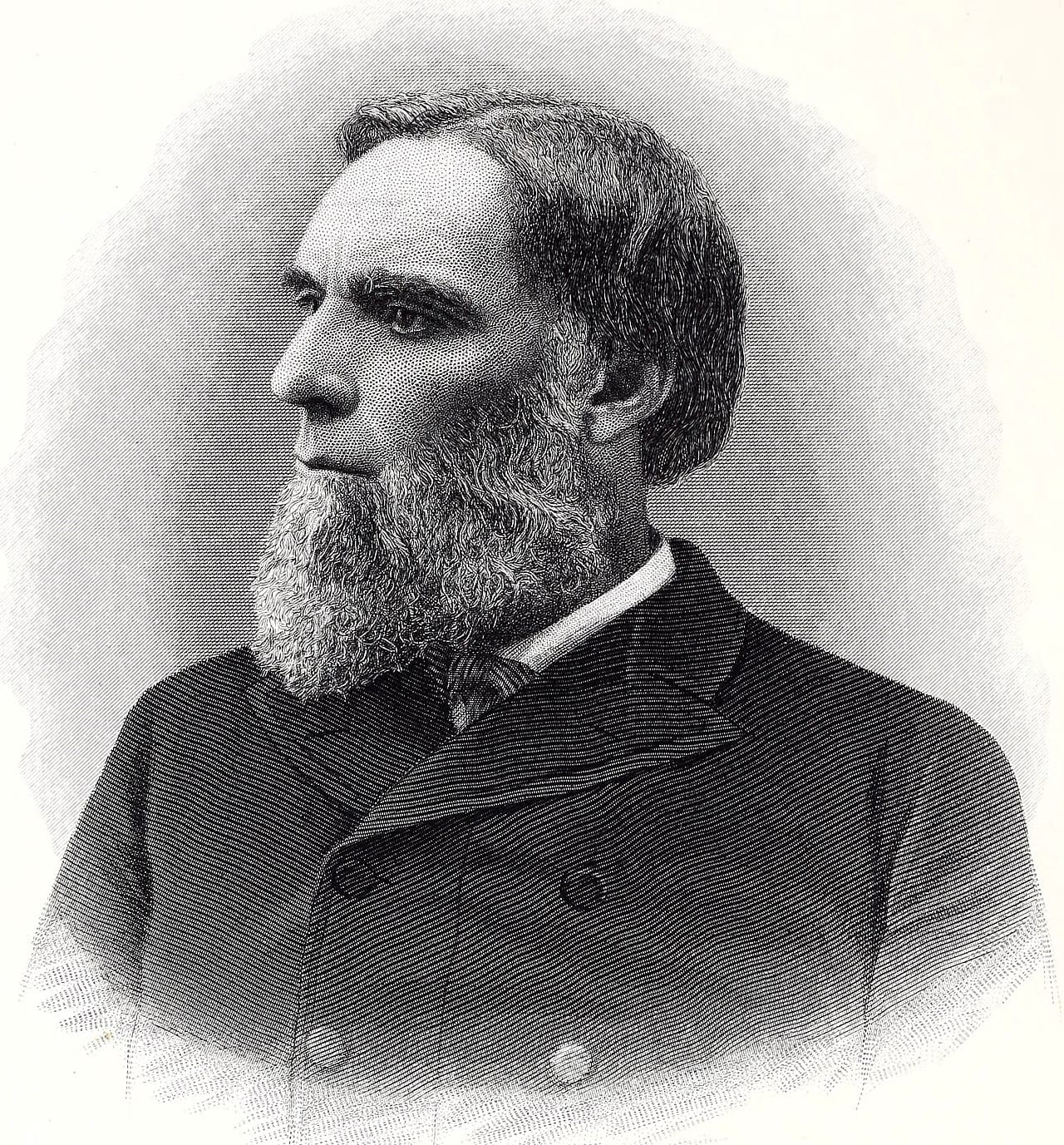
Mr. John Dillon. If you are into old state supreme court justices, you can read about him here.
He is significant today because he thought that local government was “unwise and extravagant,” and state governments were like, ooh I like that – we will be the wise ones with all the power. Over time, a lot of other states have altered this restrictive form of government because they realized how obnoxious it is in practice. But not in Virginia. Here, it’s more like ‘one Dillon to rule them all.’
“Virginia’s interpretation of the Dillon Rule is one of the strictest in the country.”
Anyway. It’s important to know that local governments in Virginia do not have the freedom to govern their communities in the way that they see fit, or in the way their residents would necessarily like them to. We are all bound (for now) by the whims of a very old, very dead guy, who wasn’t even from Virginia.

So. I thought it would be worthwhile to spend some time looking at what the Dillon Rule means and how it affects us.
The first resource I want to point to is this Bold Dominion podcast episode. (also shoutout to podcasts that also include transcripts!)
This whole podcast is a fantastic look at a wide variety of Virginia politics, and the introductory voice you hear is none other but Albemarle County Planning Commission member and WTJU general manager Nathan Moore.
The podcast quotes one person who says, “I think in general, what you see in terms of the politics of Dillon's Rule is that the state legislature likes to be able to govern from Richmond.”
Ok, but if that is the case, then why is the General Assembly only in session for a month or two? If they are going to choose a form of governance that requires so much interaction with local governments, then they should be in session year-round, or at the very least, longer like nearly every other state is. (We seem to have one of the shortest legislative sessions in the country.)
One of the people they interview in the episode, Richard Schragger, has a great article that’s not terribly long, and has a thorough history of the failure to do away with the Dillon Rule in Virginia, and it includes this great quote:
“Virginia remains skeptical of devolving substantial power to local governments. This skepticism is somewhat ironic in the home state of Thomas Jefferson, perhaps the most famous proponent of small-scale, yeoman oriented republicanism.”
The Dillon Rule in Albemarle County is also covered in our Land Use Law Handbook. This is a great resource if you ever have questions about zoning, land use, and related laws. And it lays out very clearly and exactly what the rule means:
“The Dillon Rule (also referred to as “Dillon’s Rule”) provides that a locality’s governing body has only those powers expressly granted by the General Assembly, powers necessarily or fairly implied from the express powers, and powers that are essential to the declared objects and purposes of the locality.”
“The rule itself is the result of Dillon’s distrust of city government.”
“The Dillon Rule limits a local governing body’s ability to address local issues using local strategies that could be exercised under its general police power.”
Did Virginia ever contemplate getting rid of the Dillon Rule? They actually did, when they were rewriting Virginia’s 1971 constitution. Bet you can’t figure out what they decided.
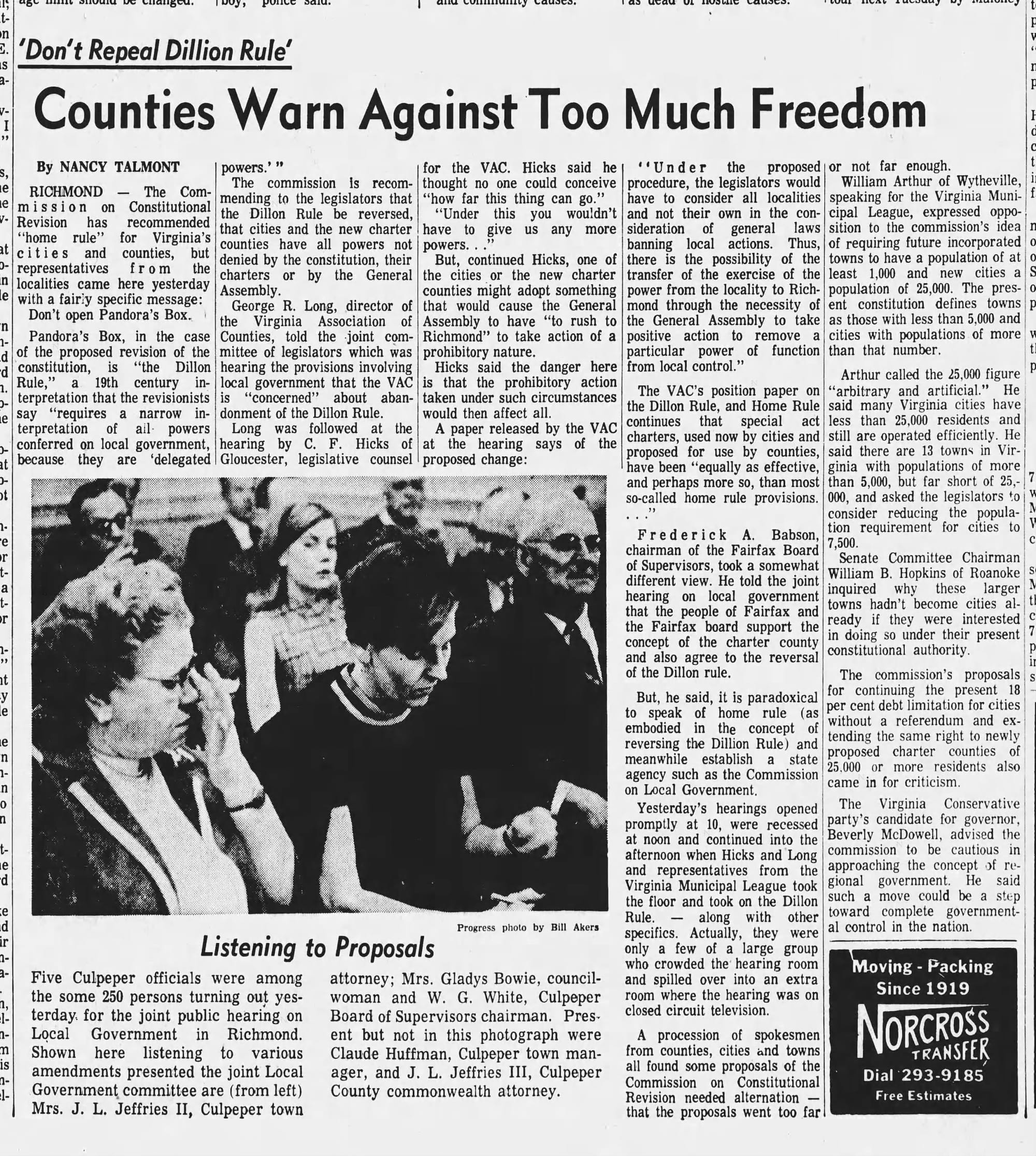
Here’s a nice little history of the current 1971 constitution if you want to learn more about that particular bit – and how we have 54 amendments to it!
But other states have modified the way they share power over the past century, and have taken back some power from J.D. “Today, at least 47 states have adopted some form of home rule for their localities.”
And you can see how that impacts policy. Here is an overview of Dillon’s Rule across various states with examples related to public health, which shows some of the really practical impacts of this. This idea of who has the power to govern has real consequences.
As I will tell my students when we study this topic in a couple of weeks, some of this tension occurs because of the way the government of the United States is set up. You want to have some protection from and consistency with your state government. If you happened to have a local government completely going off the rails, you want to have some greater authority and protection. As the public health article describes, the idea of ‘preemption’ is important.
“Preemption is a legal doctrine through which a higher government limits the authority of a lower government. The preemption doctrine is founded in the Supremacy Clause of the U.S. Constitution, which elevates federal law over state law and displaces state laws that are in conflict with federal law.”
But to my mind, there is a vast difference between upholding state laws in the interest of the public good and severely limiting the power of local governments to govern their local communities.
You probably already know that if you bag your items with plastic bags in Albemarle County, you pay a 5-cent tax on each bag. That only finally happened because the General Assembly finally passed a law giving us the enabling authority to enact that tax (enabling authority means that we have been granted the power to do something specific.) That tax now brings in well over 100k in revenue, (but of course, the General Assembly also has limits on how that money can be used.)
The other thing I find frustrating about the Dillon Rule is that just because the General Assembly gives permission for one municipality to do something, it doesn’t mean that all municipalities of that size or type can do that.
This is particularly frustrating right now, because Albemarle County would like to join this list of communities who issue a 1-cent sales tax to help fund school construction projects. Hopefully, this year will be the year for it. But why can’t that just be a blanket law for everyone across the commonwealth? It doesn’t force anyone to issue that tax – it just allows it.

The Dillon Rule also affects housing policies.
“Take inclusionary zoning as a prime example. Fairfax County, along with six other localities explicitly named in state code, has broad powers to provide incentives for affordable housing units in new developments. Most importantly, these communities also have the power to require those set-asides in nearly all new residential construction.
But in Richmond, Norfolk, and every other localities? State law keeps those powers highly limited and tightly prescribed.”
Here’s another older, local story about how the Dillon Rule can have serious inequitable consequences.
Like I said. Frustrating.
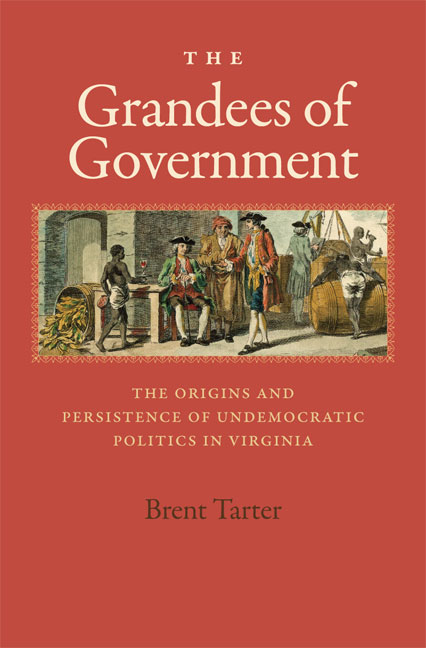
If you really want to take some time and learn more about the political history of Virginia as its own entity and not Virginia-as-U.S.-History, here are two books that look interesting, and are also fairly recent. I am always incredibly hesitant to recommend books that I haven’t read because it can be very risky, but I’m going to do it anyway since this topic is relatively niche and the author seems to be a respected scholar who knows what he's talking about.
The Grandees of Government
<div><p>From the formation of the first institutions of representative government and the use of slavery in the seventeenth century through the Americ

Constitutional History of Virginia
This is the only modern comprehensive constitutional history of any state, and as a history of Virgina, it is one of the oldest and most complex. Virginia’…
 Brent Tarter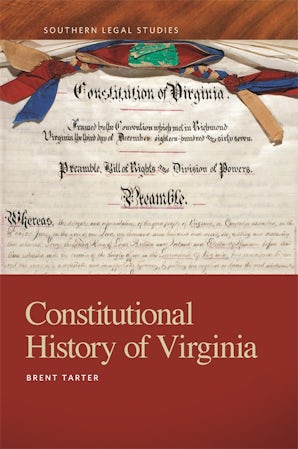
And if you don’t want to read a book but would listen to an hour long video about this constitutional history, the Virginia Museum of History and Culture has you covered!
Understanding the Dillon Rule is really important to understanding why we can’t do all the things we would like to, and I anticipate becoming even more frustrated with it over the next few years! Virginia’s General Assembly was created in 1619. It is the oldest lawmaking body in North America, which is pretty cool, but as much as we love history, we do not need to be bound to it.

Subscribe to my newsletter
Subscribe to stay updated on what I'm up to!